As we mentioned in the Livestock post, a sow was due any day. We are happy to announce that the ARI community has increased by 11 piglets.


Going to Japan with the Governor
Serving as long-term mission volunteers at ARI. Friendship. Farming. Inspiration.


As we mentioned in the Livestock post, a sow was due any day. We are happy to announce that the ARI community has increased by 11 piglets.
ARI has chickens, goats, and pigs. Scott has been assigned to chickens then pigs, while Chrys has been assigned to chickens then goats. This means that during food life work (FLW) each weekday we feed, water, and clean the animals from 7-8AM and 4-5PM. On Saturday we only have FLW in the morning, and the rest of the weekend people are assigned one more FLW slots to spread the work around while ensuring the animals are tended to.
The goats are pretty much everyone’s favorites. They are kind of cute, relatively clean, and have their own personalities.

There are only six goats, so they are easy to maintain. They also are the only animals with names (after characters in the movie Frozen). And they provide milk for supper.
Pigs are next on the list. The small ones also are kind of cute, but they get less cute as they get bigger, and the big ones are kind of scary. The biggest weigh 135kg (about 300 pounds), so get out of the way if they are moving in your direction. We have about 50-60 pigs of all sizes, although that number will change any day because one of the sows is about to have piglets.

And of course they produce a lot of manure. Not so fun. But we use that manure to produce methane gas, compost, and fertilizer, among other things. We also eat a lot of pork at ARI, so thank you pigs.
It is hard have much affection for the chickens. Most of the chickens are “layers” – we eat a lot of their eggs and sell the rest. Fewer are “broilers” – raised for meat. There are about 200 chickens.
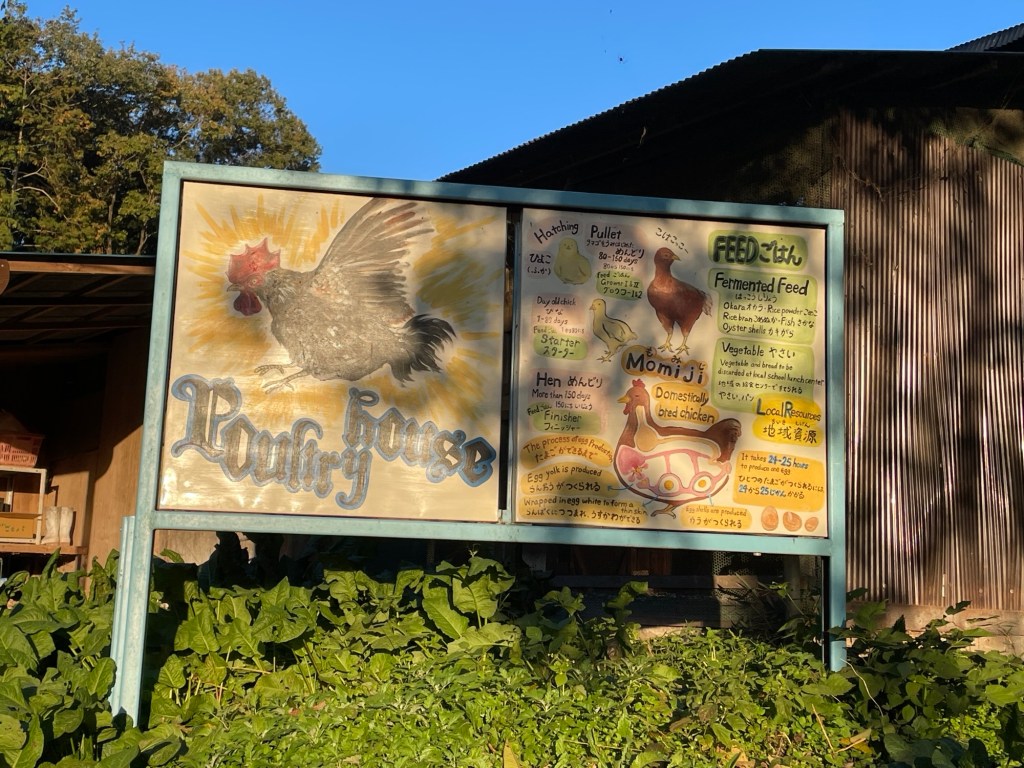
Actually feeding and watering the chickens is not so bad. But the mixing room, where we mix what eventually gets fed to the chickens, is the least appealing spot on the ARI campus. We will not go into any more detail, but here is a video glimpse.
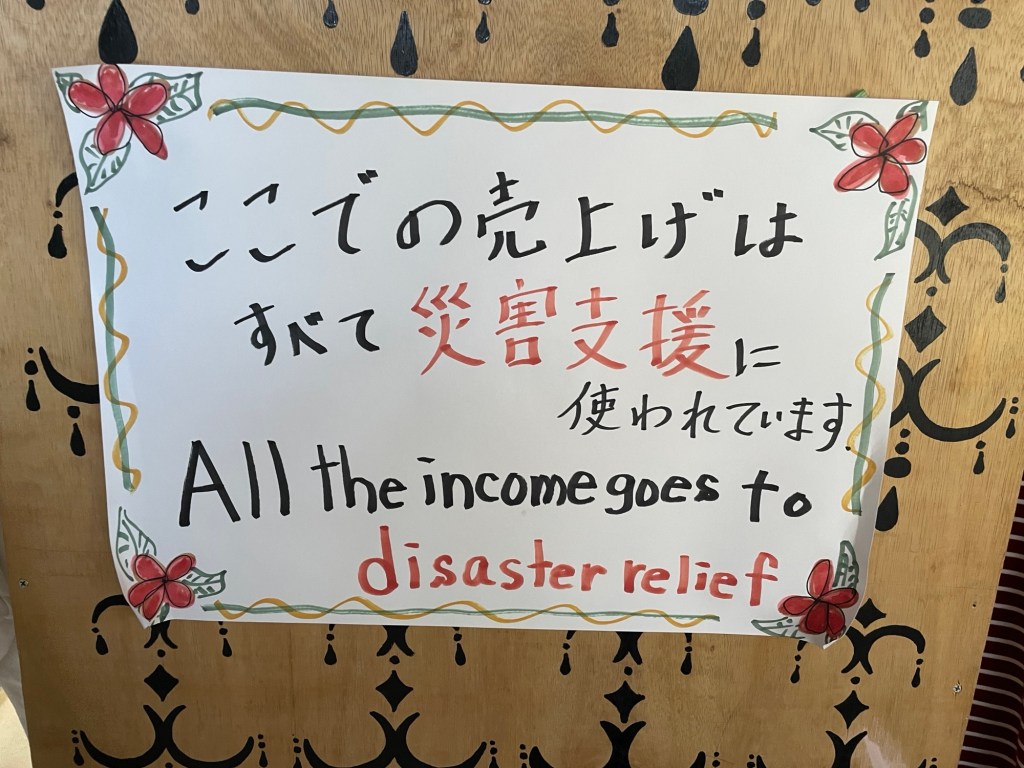
Boutique is ARI’s second-hand clothing store. It is open for 45 minutes each Thursday. The store offers clothing that has been left behind by prior participants and volunteers or has been donated by businesses and organizations. Pretty much everything costs 100 yen (about 65 US cents).

Participants use it to supplement their wardrobe, as they arrive in early spring and stay until winter, so it is impossible to bring all the necessary clothing. Plus many of them have no cold-weather clothes anyway, because it does not get cold where they live.

Everyone uses Boutique to get their first “Japan clothes”. We have chickens, goats, and pigs at ARI, and quarantine rules prohibit working around the livestock in clothes that have not been in the country for at least four months. Recognizing that everyone from outside Japan will need some livestock wardrobe basics, participants and long-term volunteers are given an allowance of five pieces of clothing from Boutique before being charged for everything else.
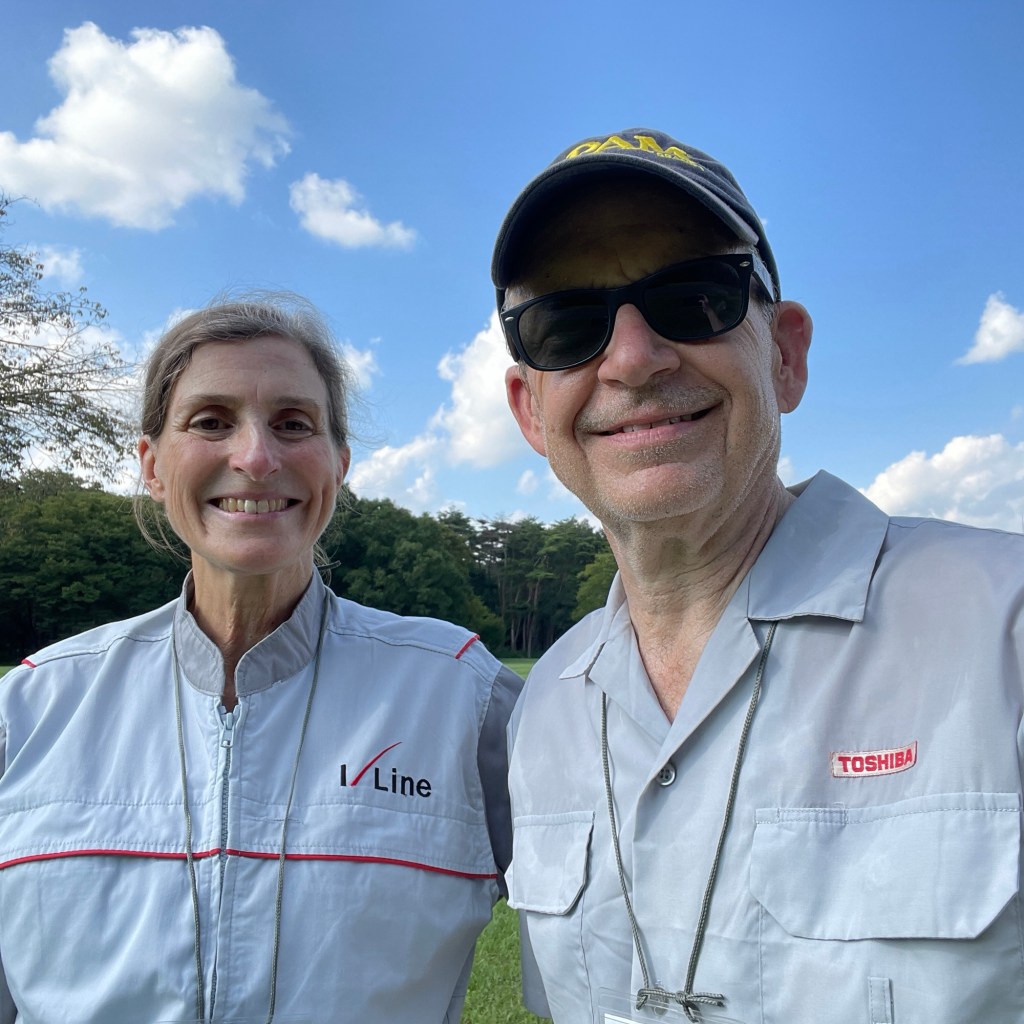
We snagged some real deals in our first foray to Boutique. In the picture above Chrys is wearing a worker’s shirt from I-Line, which appears to be a defunct company. A lot of people at ARI wear I-Line shirts, hats, and jackets, so the company’s failure must have been a boon for Boutique. Scott is sporting a worker’s shirt from Toshiba, which he thinks is pretty cool.
Almost everything we eat at ARI comes from our farm. At every meal we eat rice harvested from our fields. Almost every day we eat eggs from our chicken (and sometimes the chickens themselves), and several times a week we have pork from our pigs and milk from our goats. Most dishes use onions from our fields and side dishes include a variety of vegetables from the gardens.
We have eggplant with every meal because we are harvesting them and eggplant does not keep. After we return from ARI it will be a loooooooong time before we have eggplant at home. Just saying.
Here is an example of how fast we do farm to table.

Friday morning we were on the Farm team that harvested a few of our soy beans plants.

Back at the Farm shop we separated the pods (the rest of the plant is used for livestock feed).
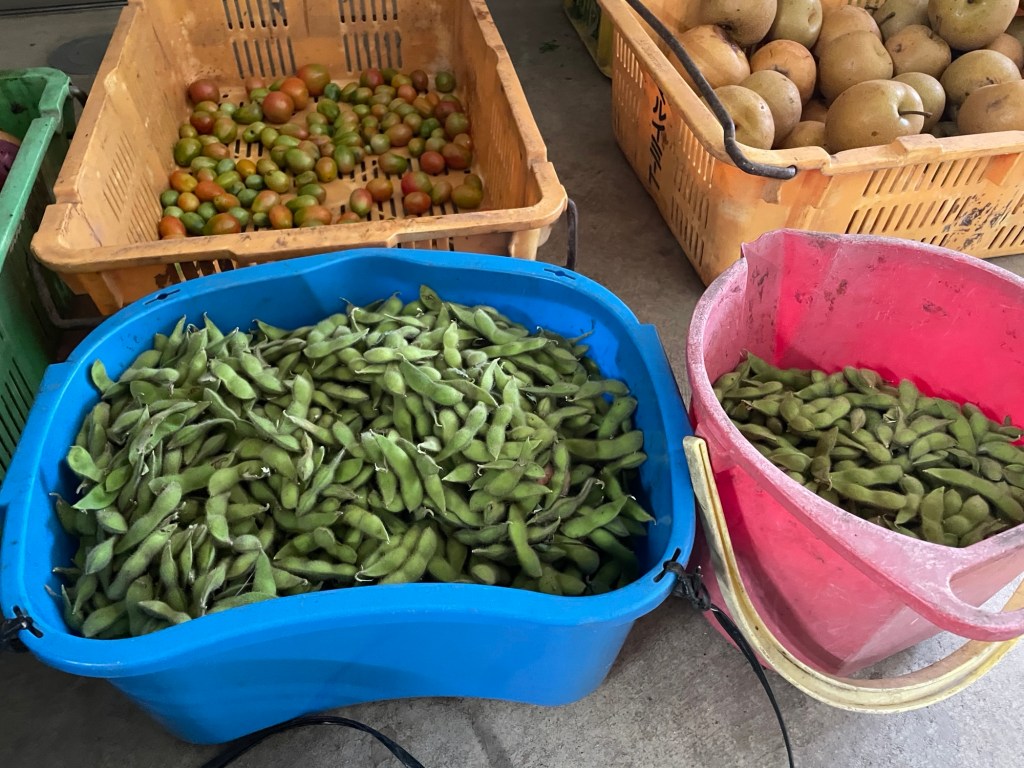
And that evening we had edamame for dinner.
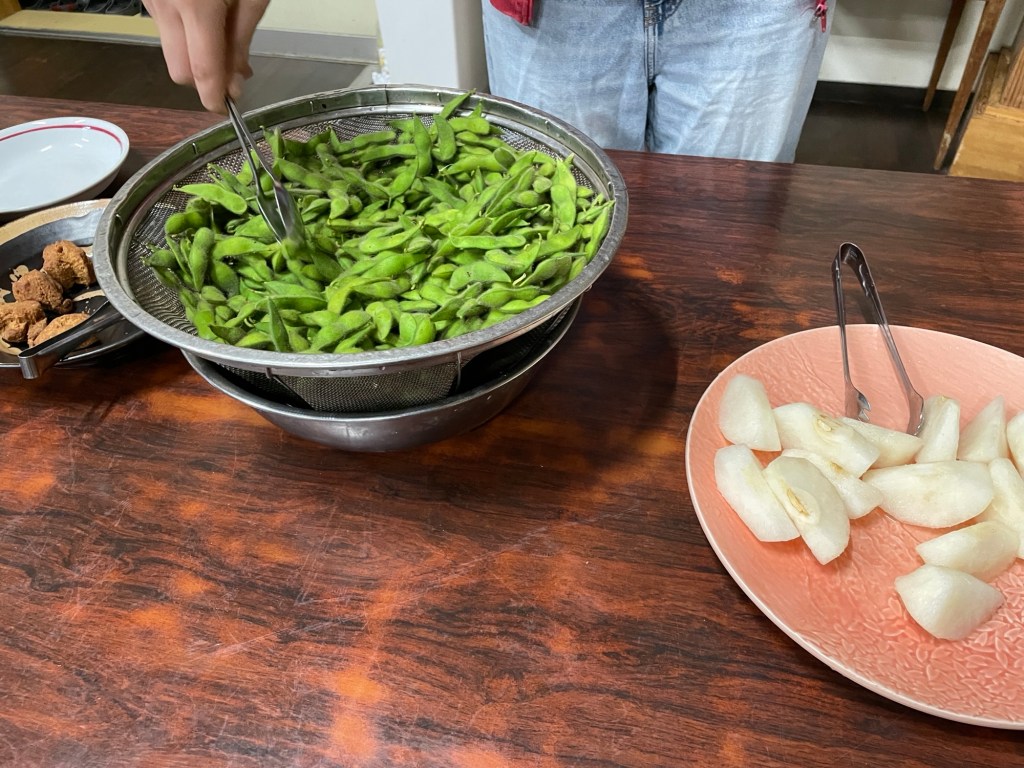
Many people live this way, of course, and most people lived this way not long ago. But in North America and many other places we have become disconnected from our food sources. That matters. What do you feed the chickens and the goats, and how do you care for them, when you know you will be eating the eggs from those chickens and drinking the milk from those goats? What chemicals do you (or don’t you) spray on the soy beans when you know you will be eating those beans?
“Sunrise Farm” sounds like a yogurt brand, but at ARI it is an activity. Namely, this week Scott has been in a carrot field at 5AM each morning, where the Farm team is thinning out the carrots.

Work at ARI is carefully (but to the newcomer, confusingly) assigned among participants, staff, and volunteers. Each ARI volunteer is assigned to two work teams. One work team is a permanent assignment for the during of their stay. The other work team assignment changes monthly.
Chrys’ permanent assignment is a FEAST team that prepares lunch for everyone at ARI (the numbers vary but around 60 each meal) and then does kitchen clean up and maintenance after lunch. Her rotating assignment is the Chicken team. That is exactly what you think. The Chicken team does one work shift in the morning and one in the afternoon.
Scott is permanently assigned to the Farm team. Again, the name explains it all. Ordinarily the Farm team also does a morning and an afternoon shift, but it has been so hot here that the afternoon shift has been moved to “sunrise farm”, which starts at 5AM. His rotating team assignment is a different FEAST team that prepares breakfast and supper for everyone here.
That is how it works during the week. On weekends everyone pulls one Saturday shift with their rotating team. This is, after all, a farm with chores to do every day. So on Saturday Chrys and Scott will do a morning shift at Chickens and FEAST, respectively. All other weekend duties are spread out among everyone (participants, staff, and volunteers) and change each week. As it happens this weekend we both have FEAST breakfast duty on Saturday.
We have arrived at ARI and settled into our room in the guest house (pictured).

The participants (students) and other volunteers stay in men’s and women’s dormitories, but as a married couple on a long term volunteer placement we got the upgrade, including air conditioning, which is a real bonus as it has been unusually hot here.
And about the title of this post. We got a tour of the campus this afternoon. We raise pigs and goats and chickens, among other things. When the time comes the pigs and goats are sent off site for “processing”. But the chickens are done in house, so to speak. As we were shown the chicken-killing room our guide explained that each participant is required to take shifts killing chickens (unless they have a religious or cultural prohibition). But as volunteers we are not required to kill any chickens. Chrys immediately accepted the exemption, but Scott might try his hand at it. We shall see when the time comes.
The title quote came from that discussion.
