Going to Japan with the Governor

Serving as long-term mission volunteers at ARI. Friendship. Farming. Inspiration.

Category: Farm

  • “At least they died as Christians ….”

    This morning 75 ARI chickens met their maker. Next week is the annual Harvest Thanksgiving Celebration, or HTC (more on that to come in another post), and the ARI community will be preparing an international menu of food for our guests from the area.

    Scott is on the HTC Food Committee. The committee did the math and determined that all the dishes would require a total of 75 chickens. The committee also decided that October 7 would be Chicken Butchering Day – a day that will long live in Scott’s memory.

    Uncle Timo is in charge of ARI’s chickens. He took charge of slaughtering them, then the committee members took over. There is an ingenious and somewhat terrifying contraption that removes most of the feathers. The rest of the feathers needed to be removed by hand.

    Then the butchering began. Scott had never butchered a chicken, or anything else for that matter. The closest has been carving a Thanksgiving turkey. Fortunately Kenwang was at the next station and showed Scott what to do, then patiently answered his questions as they went along. Scott learned more about chicken anatomy than he ever wanted, to be honest. Off came the head and feet, then out came the innards. We keep the head, feet, and many of the innards. The rest goes into the ARI compost, which itself is a thing to behold.

    We will stop the chicken-deconstruction description there, and mercifully there are no pictures (you are welcome, Joy). There was, however, a film maker who shot video of the whole thing, and frankly it seemed like he took waaaay more video than necessary to show chickens being butchered. But what do we know about film making?

    The whole thing took a couple of hours, including cleanup. You cannot imagine the mess. Then we went to lunch. Lunch was vegetarian (whew).

    Oh, and about the post title. Our chicken wrangler Uncle Timo also is the head of the local Otawara Christian Church (more on that to come in another post). Folks in the butchering room were joking with Uncle Timo about whether he had baptized the chickens (at one point they go into a hot bath) and he joked yes, “at least they died as Christians.”

  • Onion update

    About ten days after we planted the seeds, the onions are doing well.

    Seedlings at ten days. The long thin plants are onions, the rest are weeds.

    Today we weeded the seedlings. It can be very meditative work.

    Patient work.

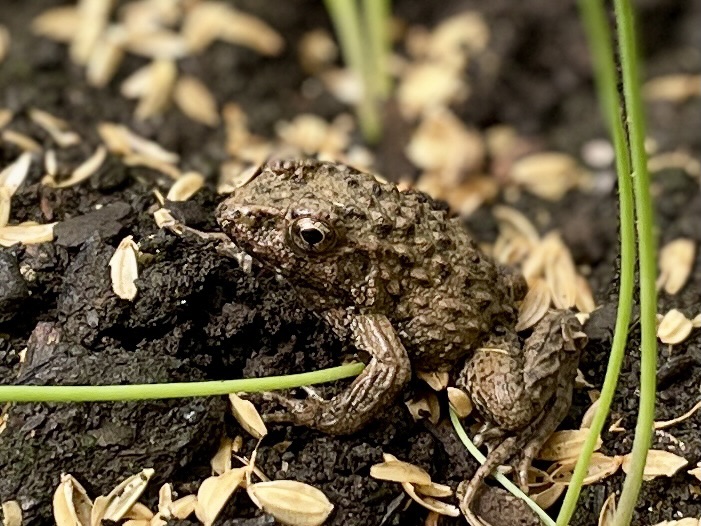
    And we had company.

    It was hard to take its picture because it disappeared into the earth.
  • “Farm to Table” – when the table is in the middle of the farm

    Almost everything we eat at ARI comes from our farm. At every meal we eat rice harvested from our fields. Almost every day we eat eggs from our chicken (and sometimes the chickens themselves), and several times a week we have pork from our pigs and milk from our goats. Most dishes use onions from our fields and side dishes include a variety of vegetables from the gardens.

    We have eggplant with every meal because we are harvesting them and eggplant does not keep. After we return from ARI it will be a loooooooong time before we have eggplant at home. Just saying.

    Here is an example of how fast we do farm to table.

    A soy bean plant ripe for harvesting

    Friday morning we were on the Farm team that harvested a few of our soy beans plants.

    The harvest is plentiful, but the laborers are few.

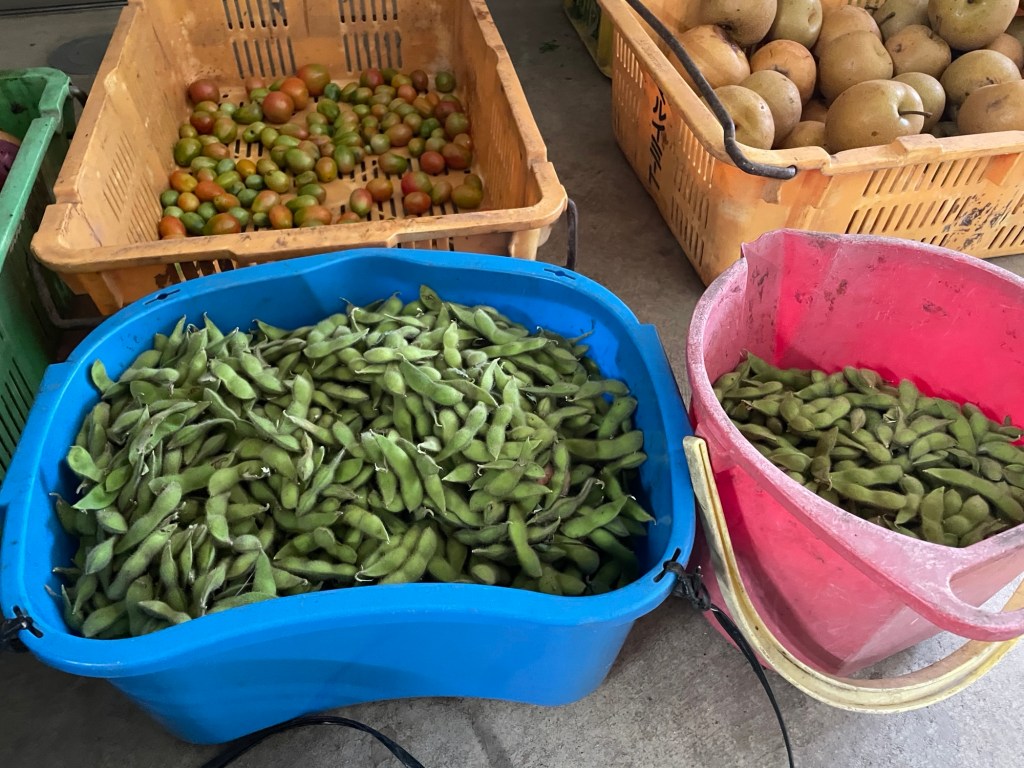
    Back at the Farm shop we separated the pods (the rest of the plant is used for livestock feed).

    Buckets of soy beans outside the kitchen .

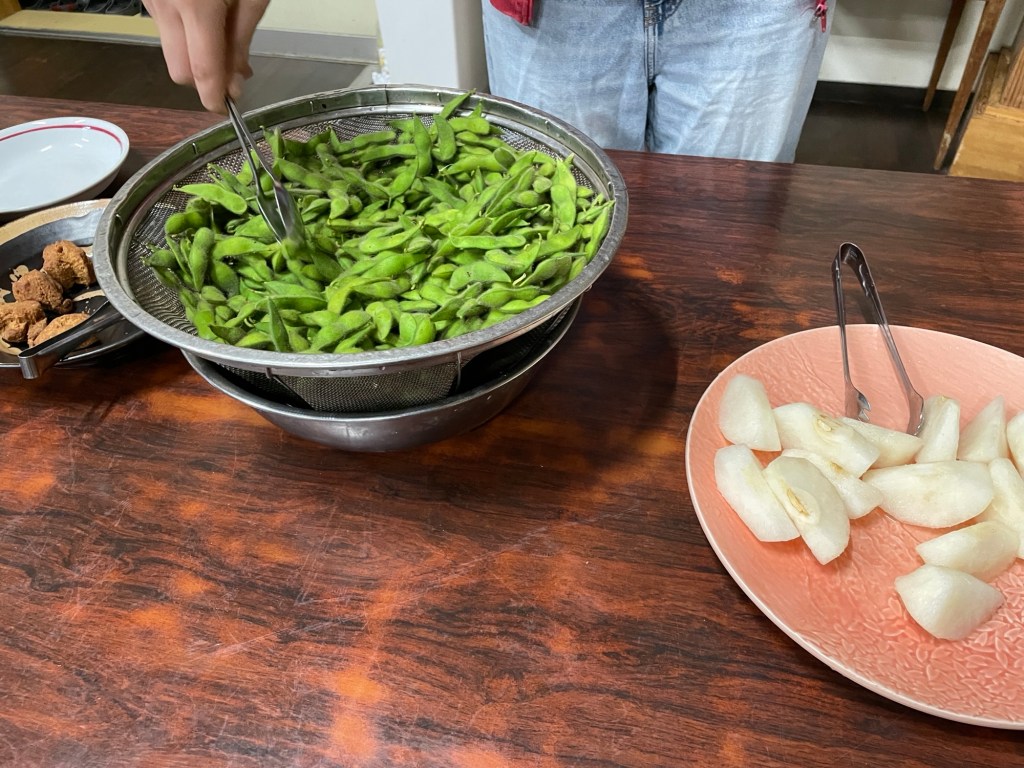
    And that evening we had edamame for dinner.

    Many people live this way, of course, and most people lived this way not long ago. But in North America and many other places we have become disconnected from our food sources. That matters. What do you feed the chickens and the goats, and how do you care for them, when you know you will be eating the eggs from those chickens and drinking the milk from those goats? What chemicals do you (or don’t you) spray on the soy beans when you know you will be eating those beans?

  • Couples therapy (updated)

    What are we doing in this picture? Wrong answers only in the comments. But we would be shocked if anyone had the correct answer anyway. We will update this post in a few days with the answer.

    (Update) We are storing silage in barrels. Silage is corn fodder that is converted into livestock feed through fermentation.

    That morning a team of participants had harvested the feed corn. (Most corn in Japan is grown for livestock feed.) The corn stalks are cut at the base.

    In the afternoon we ran the entire stalks, including the leaves and the ears, through a wood chipper. That leaves a large pile of shredded corn. You can see some of it on the ground.

    What we are doing in the photo is putting the corn fodder into barrels with some ground rice husk to encourage fermentation. While Chrys sat on the overturned barrel to the left of the picture, Scott would put three pitchforks full of corn material into the barrel, then two handfuls of rice husks, and mix it up a bit. Then Chrys would get into the barrel and stomp it down. She has plastic bags on her boots to prevent dirt from the boots getting into the barrel.

    Repeat until the barrel is full. Our team filled up about 15 barrels over two days.

    A barrel of fun.

    There are two methods of compressing the material in the barrels. Chrys opted for the stomping method, but some of the younger and more energetic team members opted for more of a jumping method, shown in the video.

  • “You arrived looking like a lawyer, now you look like a farmer.”

    So said one volunteer to Scott the other day. As the expression goes, Scott is not a farmer, but he plays one in Japan. And he sure works like one. As you may recall from an earlier post, Scott is assigned to the Farm team for the duration of his time at ARI.

    Happiness is a weeded soy bean field.

    ARI teaches and practices sustainable, organic farming. Which means no herbicides or pesticides in its fields. Which means the fields are weeded by hand.

    Since Scott arrived the Farm team has spent most of its time weeding the ten soy bean fields around ARI. The Farm team works two hours in the morning and two hours in the afternoon (now that Sunrise farm is over). That is a lot of weeds. Scott also has spent a morning picking beetles off soy bean plants (no pesticides).

    Farm team also has been thinning out carrots. Carrots are planted three seeds per hole and some seeds do better than others. So at a point the team goes out and pull the smaller carrots and leaves the biggest carrot to grow. The pulled carrots are fed to the livestock.

    Even though we stopped Sunrise farm it still has been unusually hot and humid. Afternoon temperatures get into the mid-80s and the morning humidity is 95%.

  • Sunrise farm

    Sunrise Farm” sounds like a yogurt brand, but at ARI it is an activity. Namely, this week Scott has been in a carrot field at 5AM each morning, where the Farm team is thinning out the carrots.

    Sunrise farm. Photo taken at 5:18AM.

    Work at ARI is carefully (but to the newcomer, confusingly) assigned among participants, staff, and volunteers. Each ARI volunteer is assigned to two work teams. One work team is a permanent assignment for the during of their stay. The other work team assignment changes monthly.

    Chrys’ permanent assignment is a FEAST team that prepares lunch for everyone at ARI (the numbers vary but around 60 each meal) and then does kitchen clean up and maintenance after lunch. Her rotating assignment is the Chicken team. That is exactly what you think. The Chicken team does one work shift in the morning and one in the afternoon.

    Scott is permanently assigned to the Farm team. Again, the name explains it all. Ordinarily the Farm team also does a morning and an afternoon shift, but it has been so hot here that the afternoon shift has been moved to “sunrise farm”, which starts at 5AM. His rotating team assignment is a different FEAST team that prepares breakfast and supper for everyone here.

    That is how it works during the week. On weekends everyone pulls one Saturday shift with their rotating team. This is, after all, a farm with chores to do every day. So on Saturday Chrys and Scott will do a morning shift at Chickens and FEAST, respectively. All other weekend duties are spread out among everyone (participants, staff, and volunteers) and change each week. As it happens this weekend we both have FEAST breakfast duty on Saturday.