The drinking age in Japan is 20. There are beer vending machines on the street.

But ARI is a religiously and culturally diverse community. No alcohol is permitted in public spaces. We enjoy responsibility and privately.
Going to Japan with the Governor
Serving as long-term mission volunteers at ARI. Friendship. Farming. Inspiration.


The drinking age in Japan is 20. There are beer vending machines on the street.
But ARI is a religiously and culturally diverse community. No alcohol is permitted in public spaces. We enjoy responsibility and privately.
ARI is the type of institution that attracts returnees. Many of the non-Japanese staff started as volunteers or participants, and past volunteers often return for short visits.
Recently we had two former volunteers, siblings, return for a few days. And as is the custom, they brought gifts. They are German so they brought Haribo snacks and a jar of Nutella.

They also brought a German board game. Board games are popular after dinner.


The one they brought from Germany is called Niagara. As you can see it has a North America frontier adventure vibe.

But in Germany the name is pronounced nee-ah-GAH-ra. It is actually how you might pronounce the word if it was Japanese.
It is rice harvesting season, and last week ARI harvested its six rice paddies. We ended up with 8.6 tons of rice.

The ARI harvesting began on Sunday, and by Thursday five of the paddies had been harvested by machine. These are clever machines that suck rice plants in the front, thresh the grains, and leave the straw.
Friday the entire ARI community joined to harvest the final paddy by hand. In true ARI it fashion was a party, literally. We sang a song written for the occasion while marching to the paddy in front of a special banner.
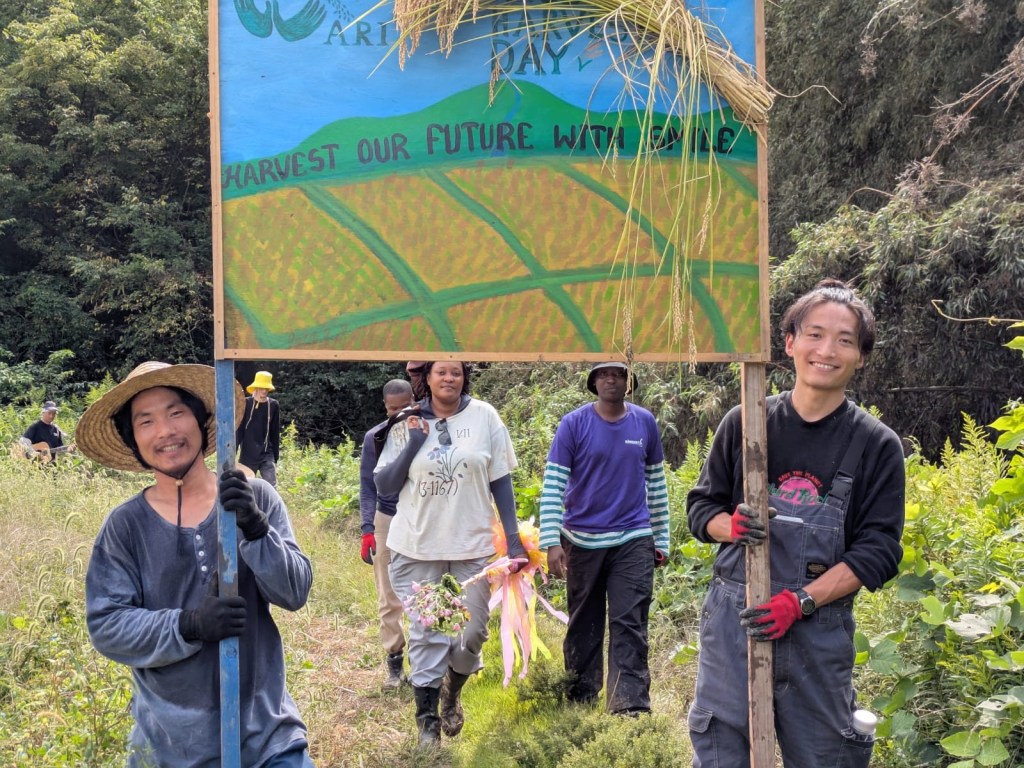
Once there we found a muddy field. Not surprising given that rice grows where it is too wet for other crops.

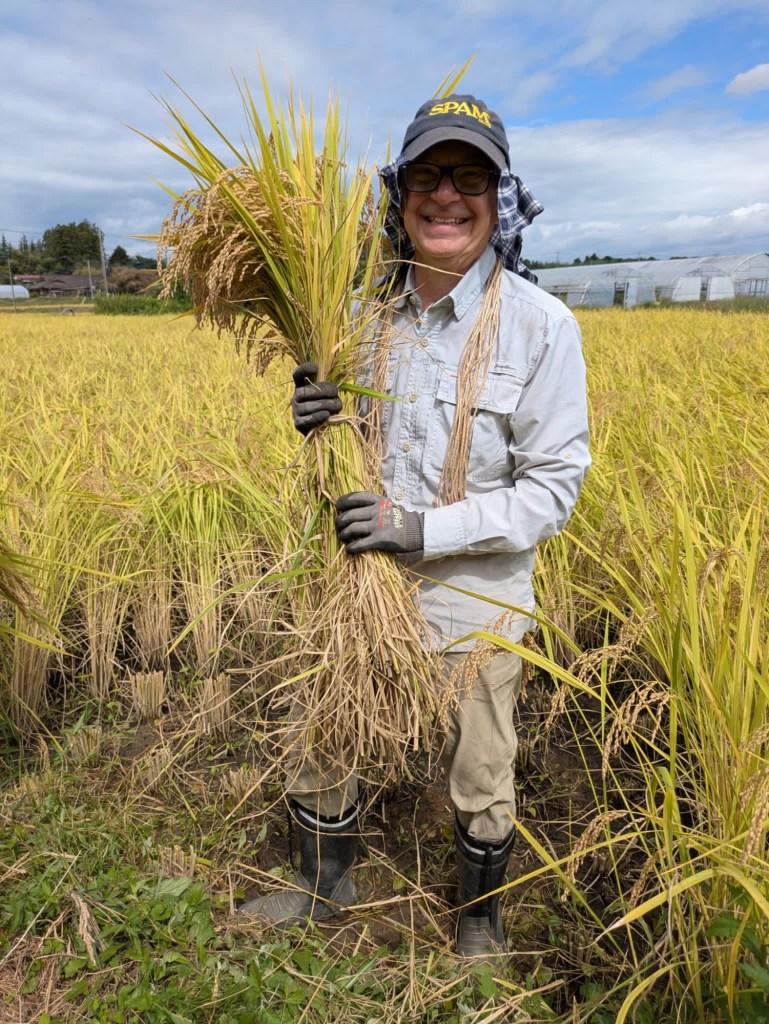
The process is to take a small sickle and cut the rice. Then it is gathered into bundles and tied with twine. (Scott and Chrys spent several hours in the prior days cutting twine to length.) The photos at the top show Chrys and Scott holding harvested bundles.

Then the bundles are fed into the same clever machine that threshes the rice.
Finally the rice grain is stored in metal tanks and the straw is stored for later use as bedding for lambs. Nothing is wasted at ARI.

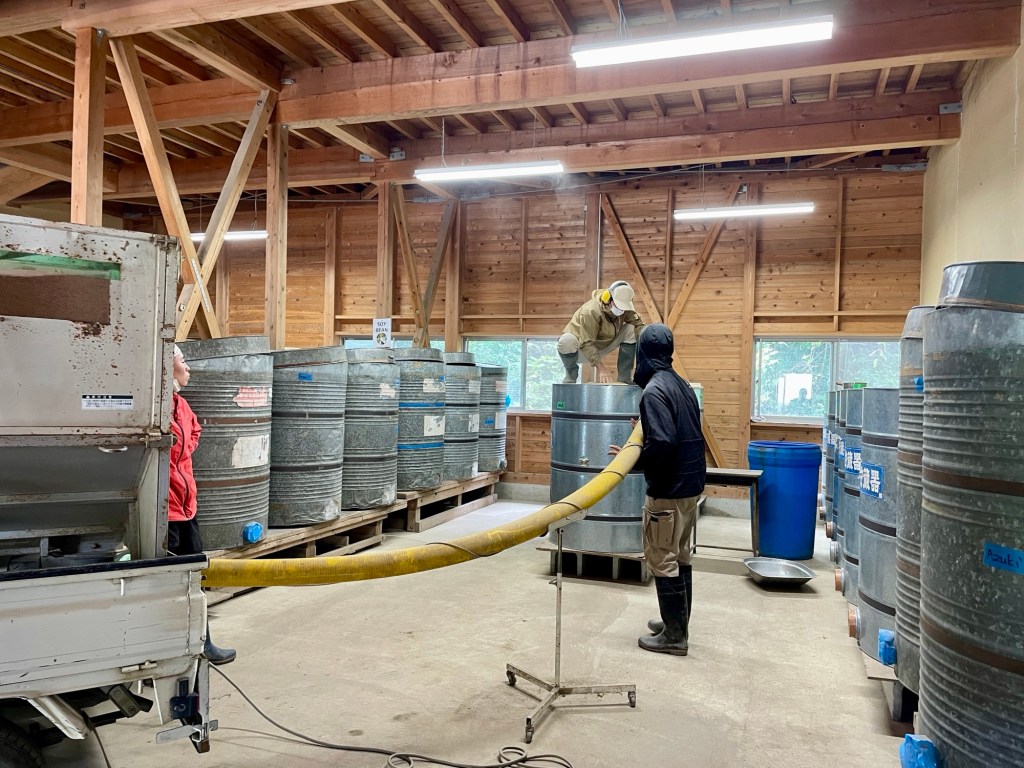
We had spent a lot of time cleaning the storage tanks and the storage room to prepare for the harvest.
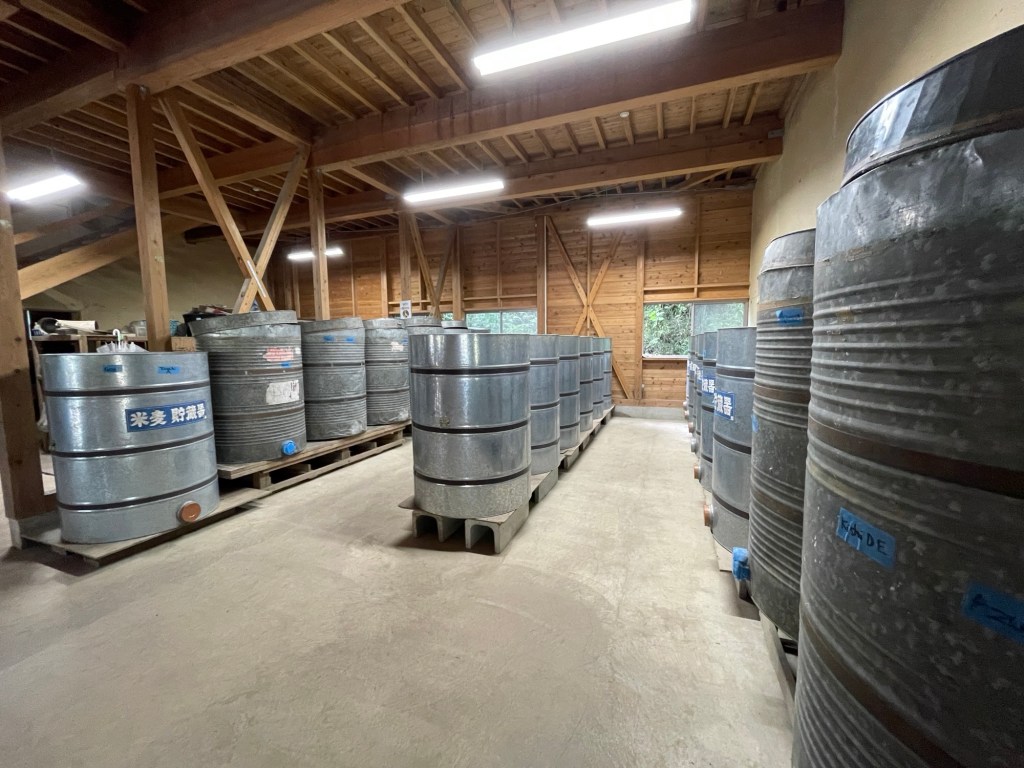
We eat rice for each meal, so a successful harvest truly is a cause for celebration.
Each Monday through Saturday the day at ARI starts with morning exercise. The entire ARI community gathers in a large circle and does a light exercise routine to music. It lasts about 3-5 minutes. Watch the video below of a bit of ARI’s morning exercise with the sound on for the full effect.
But this is not just an ARI thing. The exercise program is broadcast nationwide every morning at 6:30am on the Japanese public station NHK Radio 1. It is called Radio Taiso. Raído Taiso is done each morning in schools, work places, and anywhere there is a radio. In fact we find the key to doing morning exercise is to follow the lead of Yuko-san or Koshi-san, who grew up doing these exercises.
Radio exercise was first broadcast nationwide in 1929. The purpose is to promote social happiness as a byproduct of maintaining and improving the health of Japanese citizens. The exercises were designed to be easy and accessible for people of all ages and to be performed anywhere.
Today there are three exercise programs, Nos. 1, 2, and 3, which are broadcast on a rotating basis. The current radio exercise No. 1 has been broadcast since 1951.
You can find out more about Radio Taiso here.
We have arrived at ARI and settled into our room in the guest house (pictured).

The participants (students) and other volunteers stay in men’s and women’s dormitories, but as a married couple on a long term volunteer placement we got the upgrade, including air conditioning, which is a real bonus as it has been unusually hot here.
And about the title of this post. We got a tour of the campus this afternoon. We raise pigs and goats and chickens, among other things. When the time comes the pigs and goats are sent off site for “processing”. But the chickens are done in house, so to speak. As we were shown the chicken-killing room our guide explained that each participant is required to take shifts killing chickens (unless they have a religious or cultural prohibition). But as volunteers we are not required to kill any chickens. Chrys immediately accepted the exemption, but Scott might try his hand at it. We shall see when the time comes.
The title quote came from that discussion.
